Sit at the dinner table #9 Make a Perfectly Shaped Scallion Pancake (葱油饼) to Marry Me Off

Most of the dishes in China are regional. Like bread to the westerners here, rice is only for Chinese in the southern regions. For people living in the northern regions, steamed buns, noodles, different varieties of pancakes (饼)made of flour are the main stocks on the dinner table.

The scallion pancake is the one that both my kids love. They would order it every time a restaurant serves it when we were back in China visiting. They begged me to learn. So, here I am, learning how to make the scallion pancake.

After a few practices, I am getting better and better. The scallion pancake I made started to have many layers, crispy on the outside and soft inside. “Yummy”, my kids cried out.

But, only taste wise. Shape-wise, my pancakes are not perfectly round shaped, I can’t marry myself off, according to grandma Liu’s standards!

Grandma Liu was not my real grandma. She was a live-in housekeeper my dad hired to help my mom out. In Chinese culture, you call the elderly grandma or grandpa to show your respect.

Only in the past 30 years or so, many young girls from country villages have rushed to the big cities to seek the domestic helper’s job. When I was little, this job was mostly taken by elder women only. Some of them have a sad life story behind them, grandma Liu was one of them.

Grandma Liu was abandoned by her biological parents but was very lucky to be adopted by a very nice couple. Her dad pampered her with love and home-made toys. I would think grandma Liu had a happy childhood even though she had a rough start. Her luck ended soon after she got married. Not long after she had her son, her husband passed away. Grandma Liu was widowed in her late twenties. She never got married again.

Grandma Liu raised her son all by herself. As an illiterate woman, this was not an easy task. When she came to work for my family, her son was in his thirties.

We all loved grandma Liu dearly. She had earned our respects by being smart, happy and working hard. In those days, some basic foods such as oil, meat, egg, sugar, flour or rice in China were rationed. While we never experienced hunger, good quality foods were scarce. The government-owned grocery stores were empty most of the time and people stayed in a long line to buy fresh vegetables, fish, or anything that were not rationed.

We sometimes were eating cabbage for days because this was the only vegetable the store sold. And most of the time, they were not fresh at all. One of Grandma Liu’s unbelievable skills was that she could make the poor quality vegetables we ate for days tasted great! She would cut them into different shapes, cook them in different ways. Somehow, through her magic hands, the boring dishes were delicious to eat. That was when I started to stand by the stove watching her cooking. And that was when she started to tell me stories of her life.

We were living in a northern region then. Naturally, grandma Liu made foods from flour the most. Her cooking was like doing an art. The pancakes, dumpling wrappers were all the same thickness, perfectly round shaped. Grandma Liu said:”you have to practice hard to make the perfect shapes, make sure your kitchen is clean when you are done. Otherwise, you can’t get married, no decent men want a wife who can’t make perfect round shaped pancake. ”

Grandma Liu’s another trick that amazed my mom was she could make our very old clothes looked like perfectly ironed one without ironing them. She would carefully fold the clothes when they were about 95% dry. She put them on top of a wooden chair, then, she just sat on them, having a break herself. After a little while, the “ironing” was done and grandma Liu just got up, started doing another house chore. My mom tried a few times, she sat very still but never got the same “ironing” results.

Life was very harsh on grandma Liu. I saw her adult son coming to visit her a few times. Every time, he took money from grandma Liu. After he left, the easy smile grandma Liu always carried with her would be gone for a long while. Sometimes, I saw her staring in the distance for a long time, almost like she was kept in a horrible spell that she could not break through.

Later, when I was older, my mom told me that grandma Liu’s son was a lazy guy. At that time, most young people got married around 20, he was not married in his thirties and even worse, he was in a relationship with a married woman. He could easily get fired by just that. He squandered money he earned and always asked his mother for more money.

When my family got a chance to move to Beijing, grandma Liu was not working for us anymore but she would come to visit us sometimes. Before we moved away, my parents wanted to ask grandma Liu an important question. At that time, only very high-rank officials had a phone, mostly in their office, not their home. Grandma Liu could not read so my parents could not write to her. They went to see grandma Liu, telling her we were moving and asked her if she would like to move with us as a family member. My parents promised her that when she was too old to work, my parents would take care of her as their own parent. Grandma Liu was silent for a long while, then she told my parents that she couldn’t leave her son behind.

We never saw grandma Liu again.

Years later, we talked about grandma Liu, wondering how she was. We all hoped that at her end of life, her son had changed to be a responsible adult and treated her well. But sadly, in our hearts, we all knew this was a far reached hope.

I wish grandma Liu would know what a warm memory she had left with our family, and what an impact she had on me. Whenever I can’t make a perfectly round shaped pancake, I would remember what she said to me with a smile: you can’t marry yourself off with an ugly looking pancake.
Sit at the dinner table #8 Toasted Steamed Bun (烤馒头片) – Dad, is that you?

25445899_10210939450910078_6568034929269972600_n


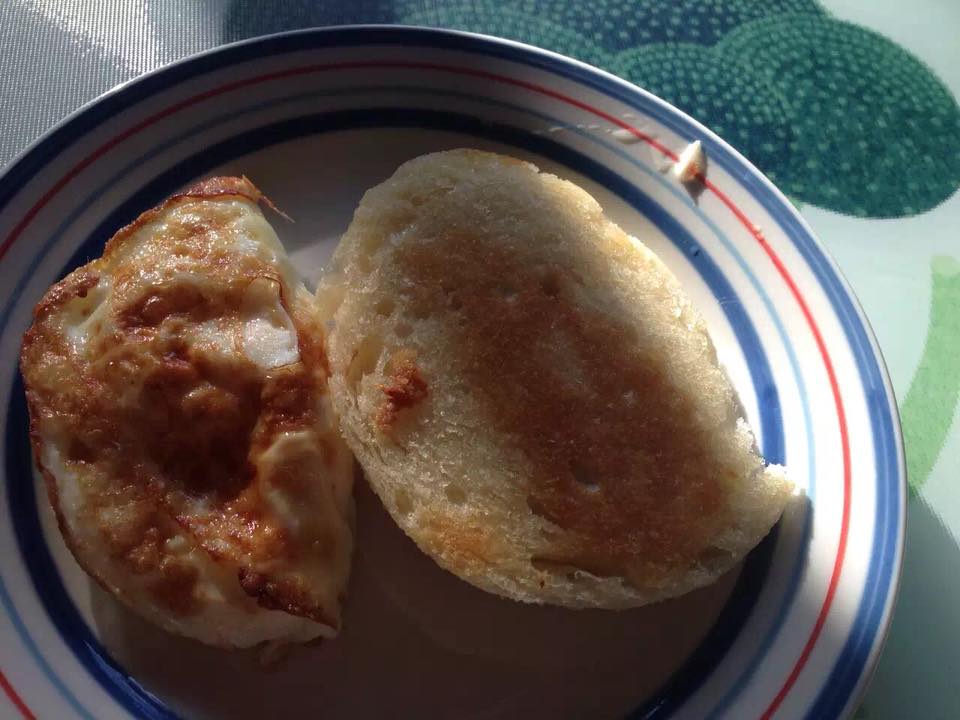
The other day, I made the steamed bun. Most of the Chinese families eat steamed bun as breakfast, not bread. And before I came to the US, I had never seen a toaster.

For the leftover steamed bun, you can re-steam it or toast it in the Chinese way: in a pan on the stove. I had added oil to fancy the “toasting”, pan frying it. While I was doing it, the morning sunlight came in from the kitchen window. For a moment, I saw my dad, standing in front of a brick and mud self-made stove (he built it), carefully and patiently toasting a few pieces steamed bun for me and my brother. The morning Sun from an open door to a huge rooftop deck, a shared place for all the college students and teachers‘ families, who co-lived in the dorm like building, shed light on my dad’s side. I could see he was paying great attention to what he was doing, making sure the toast was golden brown and crispy to me and my brother’s taste. If the cooking oil was not rationed, I was sure that my dad would pan fried them like I did it in my kitchen.

My dad was a busy college teacher but he always made sure that he would do whatever he could to bring nutritious and tasty foods on the table for his family. Sometimes, thinking about my love for foods and cooking, it is rooted in the family. My mom is a great cook and my dad was a great shopper.

Seeing my dad riding a bicycle, full of fresh vegetables, fish, and occasionally some meat on each side of the bicycle handle, back from half day’s grocery hunting trip is forever sealed in my memory. I was in my early teens, craving proteins every minute when I was not asleep. My brother was the same. But meat, eggs, and cooking oil were all rationed. It was quite a challenge for my parents, actually, almost every parent at that time to get quality foods on the dinner table. My dad managed to find a small restaurant deep in an alley, which sold meat scraped off the bones that did not require a meat ration ticket. And my mom could cook any kind of fish for a very delicious meal. Lucky me and my brother!

The steamed bun on the stove gradually pan-fried to a nice golden color, the oil brought out the aroma of the wheat, reminded me of the toast my dad did for us many years ago. I looked up, to the morning sunlight, quietly asking: “Is that you, dad?”


25443297_10210939451110083_306088659299121027_n
PS: the photo above is a collection of food ration tickets that a friend of mine saved.

Sit at the dinner table #7 A Popular “Salad” In The Summer – Smashed Cucumber (拍黄瓜)

Most of the Chinese meals are served hot, no matter it is breakfast, lunch or dinner.

Coming to the Western world, the very first thing to adjust is eating cold foods and raw vegetables called “salad”. It took a while for my stomach to get used to it. 20 years ago, it would be unimaginable that I will eat salad regularly, one big plate of it, every single morning.

Smashed Cucumber is a northern dish. The character “拍”, means “smash”, having a rugged, unrestrained personality that well fits the northerners in China. In the south, they have a similar cold dish made of cucumbers that helps to fend off the heat in the summer, but the cucumbers will be cut carefully into even slices or even fine shreds. Most of the times, southern dishes are more elaborated and northern ones are more casually prepared in China.

In the late 80s, foreigners were rare in China. I met two groups of them on trains, not the modern bullet trains that are everywhere in China nowadays but the old-fashioned green ones that burned coals. All of them were young students came to China to study or travel for fun. They were very adventurous.

They rode with ordinary Chinese people in sometimes very crowded train, squatting down or sat on the floor waiting to have a seat. The first time, it was two young guys, they even dressed in very traditional Chinese male shirts attracting lots of attention. They impressed everyone including me with their fluent Chinese, eating an apple without washing it and peeling the skin off, just a quick rub on their shirt as a “cleaning“ act. Most importantly, they touched everyone’s heart by genuinely and frequently helping some old peasants out, carrying their heavy load of produce in a dirty burlap bag to get off the train at stations that the train only stopped for 1 or 2 minutes. We had small talks. When people asked about their age, a typical question from Chinese, not a rude one, they asked me, a teenage girl then, to guess. From their beard faces, I hesitated and eventually said shyly in a low voice: around 50? They smiled, and told the curious people around they were 25. My face turned to a bloody red one.

The second time, it was a girl asking the service guy at the dining cart that grabbed attention to her. She asked in a voice with a hint of foreign accent if they had “拍黄瓜”(Smashed Cucumber). Of course, they didn’t serve that cheap, homey dish on the train. They wanted to make money off people traveling. But the passengers around were very surprised that this foreign girl knew this dish, their murmuring sounds were quite loud.

So, here you are, a homey, simple Chinese salad for the summer, a salute to all the adventurous souls who traveled in China.

1. Smash the cucumber

2. Sprinkle salt on them, sit for 10 minutes, drain the juice

3. Smash a clove of garlic, cut them into fine grains

4. Mix cucumber with garlic, one teaspoon of sesame oil, one tablespoon of soy sauce, half teaspoon of vinegar.

5. Serve and enjoy

In the pictures, I showed the kitchen knife most Chinese use, you use the side to smash cucumbers or garlic or anything you have the feeling to smash on😜. You don’t need to buy a Chinese style kitchen knife to smash things, a pestle will do the same job.


Sit at the dinner table #6 This simple cucumber and scrambled egg dish (黄瓜炒鸡蛋) is for you two, Niangniang (孃孃) and Dada (大大)


24174474_10210805219314372_5431902121650873980_n

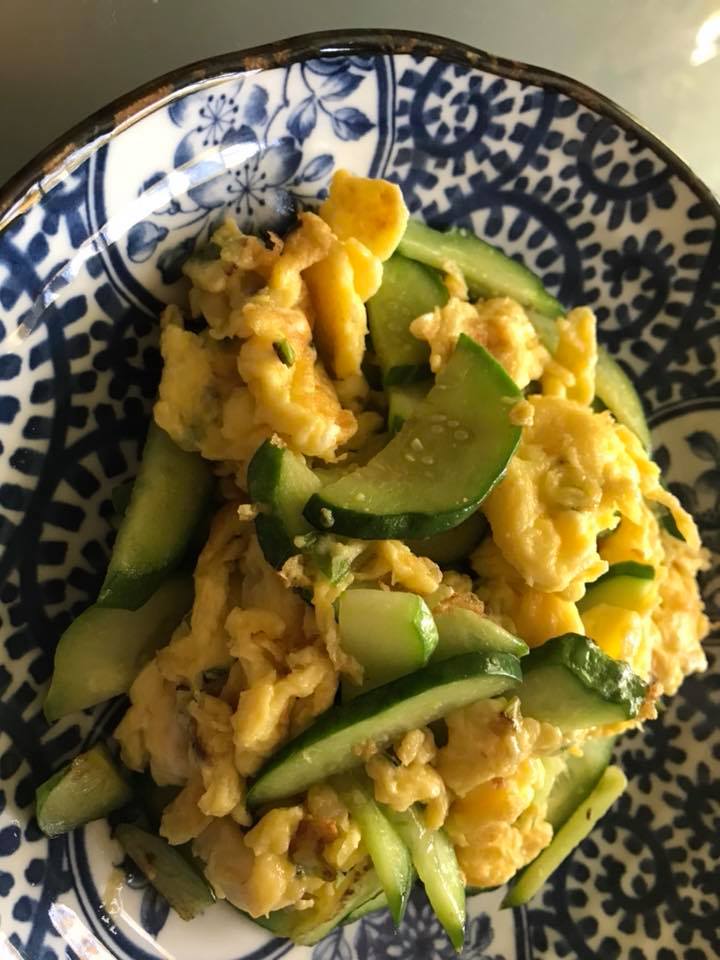
Tonight, just a lone dish on the dinner table, cucumber and scrambled egg.

Not like the scrambled eggs in the US, most scrambled egg dishes in China are mixed with vegetables. In the summertime, when cucumber is in season, this dish is on many families’ dinner table often. The cucumber’s dark green skin, tint green of its inside, mixed with the golden yellow color of eggs, preferred from cage-free chicken, are truly tempting your appetite.

To me, this dish was carved in my memory many years ago.

On May 16,1966,“Culture Revolution” started in mainland China, it lasted 10 years, brought disastrous results to the country, to the Chinese culture and to almost every family of Chinese people. I was born less than a month later.

Niangniang came to my family right before I was born. She was hired by my parents to be my nanny. None of them, my parents and Niangniang, had ever imagined then that Niangniang and her husband would become my mom and dad for a while. In Shandong province where I was born, “Niangniang” and “Dada” are dialect, Niangniang means mom and Dada means dad.

In a very short time, “Culture Revolution” showed its evil teeth. People got beaten up, some were beaten to death; homes were raided for various reasons. There was no law, no protection of anybody, except for Chairman Mao, who single-handedly started this so-called “revolution”.

My parents’ home was raided a few times, all at nights shortly after I was born. Fortunately, my parents were not hurt physically. It was then, Niangniang talked to my parents, proposing to take me to her own home. My young parents agreed immediately. They would not want me to be startled and scared in the middle of nights by violent strangers through the smashed door anymore.

Chairman Mao liked to play the “Class Struggle (阶级斗争)” card to his own power advantages. As intellectuals teaching at a university, my parents were “stinky old ninth (category)” (臭老九),almost at the bottom of the class ladder. On the other hand, Niangniang’s husband was a factory worker, who was at the top of the class ladder. In those crazy months followed, because of Niangniang and Dada my family had a shelter to hide, a sanctuary to go.

For some reason, middle-aged Niangniang and Dada did not have any kid of their own, I was their only child then. From what my parents told me, Niangniang was a woman who kept her home very clean and tidy. Dada was a fairly big guy. June is always a very hot and humid month in Jinan (济南), the capital of Shandong province, the city where I was born. As a baby, I suffered heat rashes. To relieve me from that, Niangniang had to bath me very often, sometimes using herb water in hope of soothing me. After the bath, Dada would hold me at his big belly and wave a big cattail leaf fan to dry me up and to cool me down while he was happily chatting with their neighbors. Contrary to the quietness of Niangniang, my parents said Dada had a loud voice, his infectious laugh and easy going character made him a popular figure in the neighborhood.

Dada was an honest man with a pair of dexterous hands. My parents bought me a second-hand stroller made of bamboo. Dada asked my parents to find bigger wheels and he installed them to replace the smaller ones, making the stroller much more steady and comfortable for little me to ride in. One time, while Niangniang was cooking, Dada was in charge of taking care of me, I fell off the bed and dislocated my shoulder. Dada rushed me to an old woman’s place and she successfully put my tiny shoulder back in place very quickly. If Dada chose not to tell my parents, they would not know about this incident at all.

For months, I stayed with Niangniang and Dada while my parents were having numerous “struggle meetings” at the university where they worked. In some of the meetings, high ranked officials, famous professors, and regular teachers who were claimed to be against Chairman Mao were the targets on stage, got beaten up. Sometimes to humiliate them, their heads were shaved half bare, this was being called “Yin Yang Head” (阴阳头).

Years later, when my mom told me things like that, tears in her eyes, she said a few times if she were ever forced to be shaved like that, she would not want to live. Lots of people who could not endure the torture and humiliation did commit suicide.

Sundays were the rare moments of peace for my parents. They would come to Niangniang and Dada’s home, holding me and playing with me for a few hours before they dragged their feet heading back to our own home where anybody could break in at night.

I don’t know when Niangniang and Dada stopped taking care of me but two years later, when I was barely 3 years old, my parents were forced to relocate to a small town called Qufu (曲阜). Later, when I was around 5 years old, my mom was assigned a task to travel back to Jinan. The task was she and the students she brought with to work in a factory to receive “education” from the class of factory workers. My mom took me with her.

One Sunday morning, my mom dressed me up in a nicer cloth, took me to a food store and bought a tin of very expensive cookie. My mom told me that we were going to see my nanny, Niangniang at her home. Outside Niangniang’s home, my mom stopped, telling me again that I should not eat any of the cookies in the tin even if Niangniang offered me. My mom said:”This is for Niangniang. Don’t eat any.”

To this day, I remember that Sunday afternoon at Niangniang’s home. Dada passed away at an early age, of a heart attack. Niangniang was alone. The room was very empty, seemed very big in my eyes. Without Dada, the room was very quiet too. My mom and Niangniang chatted in soft voices, I sat there quietly holding the cookie tin. I was not a girl who could sit still for a while but magically that afternoon I was a well-behaved girl, listening to the adults talking and felt content. It might be the room that protected me earlier in my young baby life had the vibe of safety and peace. Niangniang frequently looked at me while she was talking to my mom and she did offer me cookies after I handed the tin to her following my mom’s direction. I said no to the cookie remembering what my mom had repeated but Niangniang insisted. I ended up with cookies in both my hands.

Before we left Niangniang’s home, she cooked cucumber and scrambled eggs for us for dinner, the only dish on the table. At that time, when eggs were rationed, that was a luxury meal.

When it was time to say goodbye, Niangniang saw us off outside of her home. At the end of the street, I turned back to see Niangniang, still standing there, a lonely, small figure in the distance, watching us……

25395844_10210918835994718_3005078458861090200_n
This photo is from the internet. It shows a bamboo stroller similar to what I had ridden when I was a baby.

Sit at the dinner table #5 Cookie (桃酥), A Dessert Shared East and West

On Saturday, we drove along beautiful Tennessee fields for hours, trying to get to Englewood Farmer’s Market at Athens, Tennessee. Our GPS failed us a couple of times, in the middle of corn fields, soybean fields, a happy female voice announced that we had reached our destination. We looked around, seeing only the lush greens and our lone car.

Eventually, by following the signs on the winding roadside which we did not pay attention to before, we arrived at the market. It was quite ironic that by overly trusting the new technology, we did not find this Amish marketplace, the old-fashioned hand-written signs did a better job. There is a reason why Amish people isolate themselves from the modern world we are in.

We bought a whole basket of fresh vegetables and a plate of homemade dinner rolls, a package of peanut butter cookies there.

The dinner rolls are the kind you would die for. But it was the peanut butter cookies that surprised me big time!

Of course, I had peanut butter cookies many times. Somehow, this one, crispy but not hard, buttery but not overly sweet, so similar to the cookies I had in China. A bite into it took me back, thousands of miles away, many years ago, into my childhood.

The cookies we have in China is called 桃酥, walnut cookies. It is made of lard, not butter. 桃酥 is a very ordinary snack in China. However, when I was little, snacks were kind of luxury aside from regular meals. It was a treat for special holidays or visiting guests. We didn’t have them regularly. My little brother’s nanny was a nice country lady but really preferred boys over girls, a sad tradition that has a long history in China. She would give cookies to my little brother and said: “Eat it quickly, don’t let your sister see it!” It had happened so many times and I had run into my brother hurrying to swallow cookies. Even today, I could still see him holding the cookie tin tightly when he saw me coming, very nervous but determined to defend HIS cookies at any cost. It took my parents quite a while and numerous efforts to teach my little brother to share after his nanny left us.

In Chinese families, by tradition, the elderly are highly respected. So, if they could afford snacks, they would serve the elderly first. And most elderly Chinese live with their adult children. A touching scene would be the grandkids know their grandpa/grandma has a cookie tin somewhere in their home and they would look for it. Then, the kindly grandma/grandpa would take out the cookie tin, slowly open it, while all the little ones surrounding her/him tightly nudging each other a bit, hungrily smelling the escaped aroma of cookies from the slightly opened tin, watching her/his every move closely. Grandma/grandpa carefully took out cookies and gave each of the kids one or sometimes half of a cookie. A happy scene to both the grandparents and the little kids, a fond memory to them all is saved somewhere in their heart.

When my dad was in his elderly stage, he had a cookie tin too. He had stored some of his favorite snacks there, not limited to 桃酥, but also had Danish shortbreads. China has been prosperous for quite a few years then, snacks are plenty. I think, to my dad, doing that was like fulfilling a childhood dream of growing into a respected elderly, enjoying being surrounded and chased by his grandchildren.

I have enjoyed my Amish peanut butter cookie with a cup of tea. It not only brings back some memories of my childhood, my dad, but also a bit of amusement. At the Amish market check out counter, an Amish gentleman said something to me that I could not understand at first. He looked at my face, said it the second time. I was puzzled for a moment, then, realized that he was greeting me in Japanese. I smiled, said: “I am not a Japanese, I am a Chinese.” He immediately switched his greeting with 你好(how are you)! And mumbled “I usually could tell!” in a low voice.

The world is really changing, who would think an Amish guy will greet you in Japanese or Chinese?

Sit at the dinner table #4 Poached Peach in Prosecco – Drawing a Tiger by Looking at a Cat(照猫画虎)

I am not good at doing dessert at all. But Petra Rampley’s cooking post “Poached Peach with Prosecco and Rose Water” had such a beautiful presentation that I was itching to copy her. A fruit dessert this appealing to your eyes really tempted my appetite in the hot summer, so I decided to give it a try.

I wanted to do it the day I bought fresh peaches but was not able to because I found no white wine at home. To be honest, when I saw Petra’s work, I didn’t even know what Prosecco was until I googled it. To this day, I still don’t know how you get rose water, you boil the rose petals or buy it somewhere? There are so many things to learn and explore, I will leave it to my next try. For this time, I will skip the rose water.

When I went out to buy white wine this morning at Trader Joe’s, after I have put a bottle of white wine in my basket, I saw Prosecco on the shelf! I was a bit excited to see it, feeling I would be one tiny step closer to copy Petra’s work.

I followed a recipe online since I did not ask Petra for hers, again, skipping vanilla bean since I don’t have it. I carefully peeled the peach skin off after poached them. I followed Petra’s advice to simmer them carefully in the wine. When cooling them down before I put them in the fridge, I had to go to an exercise class, so I put a note to warn my family not to eat them!

It turned out surprisingly delicious even though I have cut down the sugar 2/3. Next time, I will need to reduce the water a bit more so the juice is a little thicker. The fresh smell of summer peach mixed with the subtle taste of Prosecco wine, it was a very refreshing dessert after a summer meal.

But comparing my work with Petra’s (last photo at the bottom), you see the sharp difference between an apprentice and an expert! I was busy tearing off the rose petals to be proportional with the peaches but forgot to use the petals as decoration. And the peaches Petra had has such nice color which mine doesn’t have.

There is a Chinese saying called “Draw a tiger by looking at a cat” (照猫画虎), meaning “to copy the form without understanding the substance”. This is exactly what I did. Hopefully, next time, my “cat” looks a bit more like Petra’s “tiger”.

p.s., the two small photos on the right, in the middle were my second try, they do look a tiny bit closer to Petra’s.

Practice pays off.

Sit at the dinner table #3 Tomato and Egg Stir-Fry (西红柿炒鸡蛋)- One Homey Dish You Can Hardly Find in a Chinese Restaurant in the U.S.

In the photo, my son was 12 years old standing on a stool to reach the stove top

My previous post is about Grainger County Tomatoes. Naturally, I need to write this popular summer dish “Tomato and Egg Stir-Fry” we have in China.

This is such a homey dish that it is on many Chinese’s dinner tables in the summer, no matter you live in the south or north. And it is a very simple dish that both my kids learned their very first Chinese dish by cooking this if you don’t count scrambled egg as a dish.

And it is a delicious, very colorful, very appealing to your appetite, and a nutrient dish I would think most of the people will enjoy. At least, when I served this dish to my kids’ friends, most of them love it. After my son’s college friends had it, they immediately turned to my son and asked:”You can cook this, right?”

But somehow, the Chinese restaurants here don’t have it on their menu, I don’t understand.

It takes less than 15 minutes to make this tomato and egg stir-fry, here is how:

1. cut two medium size tomatoes into small chunks (Grainger County tomato is the best)
2. beat up 4 eggs with a teaspoon salt
3. scramble the egg quickly, make sure they are tender (don’t overcook)
4. with a tablespoon oil, put in one scallion that has been cut into small pieces in the hot oil, then put in the tomato chunks in, cover your pan
5. when the tomato chunks are losing its shape (soft and the juice is bubbling), add 1 and 1/2 teaspoon salt and add in the scrambled egg, stir them together to get the tomato juice evenly cover the egg
6. Serve it with steamed rice.

Even though it is a simple, easy dish, not everybody does it right. The important trick to remember is to cook the tomato until it starts to lose shape, that’s when the sweet and sour juice brings out the taste of tomato. The most awful story came from a girlfriend of mine. She was on a trip so her two kids were in the hands of her husband for a short while. Her kids requested this dish and her husband did it. The kids tasted the tomato, egg stir-fry and turned to their dad very suspicious: “Dad, why is the tomato still cold inside?” It turned out that the dad cut the tomato into 4 big chunks, threw them into the cooking pan and undercooked them, way under.

Tomato is not a native vegetable growing in China. The other day, I was amused by an article regarding foods in ancient China. The article pretends that you have time-traveled back a few thousand years in China and you are hungry. You rush into a restaurant and quickly order some regular foods you eat nowadays. Unfortunately, one by one, the waiter tells you no, no, no! At that time, the foods you have just ordered were not seen in China YET. In the article, it listed when lots of familiar foods were introduced to China. Tomato was mentioned first in a book published in 1621. So it was around 400-500 years ago, the Chinese started to have this beautiful vegetable, or as my daughter insists, a fruit, on their dinner table.

This makes me think that actually foods are the avant-garde step of globalization probably before people at that time even understood what globe was. And I believe everybody has no objection of this kind of globalization. Who doesn’t want to enjoy a tasty new food?

Interesting!

Sit at the dinner table #2 Sugar Sprinkled Tomato (西红柿拌白糖), a Childhood Treat in the Summer and My Journey to Find the Best Tomatoes

One Saturday night, I saw a friend’s post of being at the Grainger County Tomato Festival. Grainger County tomato is our family’s favorite that we are looking forward to it each year when summer begins. We didn’t want to miss this special festival so I quickly searched to learn it went on the next day, Sunday afternoon until 5:00. My daughter had a soccer game at 12:00 on Sunday, but we were determined to make it.
The game was ended around 2:00, we had a quick bite of lunch, got into the car again, headed to Grainger County. Driving about an hour, mostly in winding country road, among lush green fields in between hills, we managed to catch the ending of this weekend festival arriving there around 4:00. We did not pay much attention to other things, all we want is Grainger County tomatoes!
We bought a whole box of it.

It is a long journey to find Grainger County tomatoes. They have the best taste we can find, beating even most of the ones from the local farmer’s market.
For many years, we ate tomato bought from the supermarket here. Depressingly, they don’t have the tomato taste we grew up with. It’s red, but a kind of faded red, not a color to appeal to your appetite. It’s hard and tasted nothing but a faint sourness that remotely reminds you of the distanced memory of what a ripen, juicy tomato tasted like. A Chinese saying can be used to describe this experience: 味同嚼蜡 – taste like chewing on wax.

A result of Industrially-Grown Tomatoes.

To be able to endure the long distance shipments, the tomatoes are picked early in the fields, green and hard, not ripen yet. Once shipped to the destination, they are sprayed with ethylene, to turn tomatoes red. Ethylene is a chemical emitted naturally by the plants in the fields when they want to ripen their fruits. Now, we, the people, ripen them at our convenience, most likely in dull, lifeless industrial buildings, not at the field where the Sun is bright, the air is fresh and life is vibrant. Of course, to do that, we pay a price: compromised taste, big time!

When I started to find the local Farmer’s markets many years ago, I have been happy to be the loyal customer. I would say about 80% of my loyalty is a tribute to tomato. The locally grown tomatoes have much better taste than the ones you get from supermarket, period.
Then, we met Grainger County tomatoes.
The natural bright red color is tempting your appetite. Mixed it in your salad bowl, it adds such a vivid color to your greens that you feel like looking at a famous drawing, by nature. Bite into it, the juice bursts into your mouth in such a fast speed that it startles your tongue. Then, your tongue can’t stop happily chasing them around. At that moment, you taste the sweet, freshness of a natural tomato, like it supposes to be!
We treasure this Tennessee jewel by having it on our dinner table often in the summertime, wondering how I missed it for years!
One dish I make from it is this simple “Sugar Sprinkled Tomato”. My kids don’t care much about it, but both my husband and I love to have it. It was our childhood treat in the hot summer.

You cut the naturally ripen tomato into chunks, sprinkle granulated sugar on them. You let it sit for a while, so the sugar will bring the tomato juice out. When we were little kids in China, we didn’t have a fridge. To make this treat cold, our parents usually floated the bowl with tomato chunks into tap water for a while. Of course, this wouldn’t have the same effect of a fridge but we were very happy to enjoy it, chewing on the bright red, soft, juicy chunks first, drinking the sweet with a hint of tart juice next. That was our taste of Summer, straightly reaching down to our heart, a moment of joy.

Sometimes, happiness is this kind of trivial things that you remember forever.
This whole box of Grainger County tomatoes was really worth the round trip of almost 2 hours.

Sit at the dinner table #1 Fresh, Seasonal Vegetables and Roasted Chicken


I love summertime.

This is the time you have farmer’s market, the time you can have locally grown, seasonal vegetables on your dinner table.

Before I dive into the two words of “fresh” and “seasonal” that is charming to me, I would like to point out that turnip, and rosemary I have used to season the chicken are two things I never heard or saw growing up in China. There is no roasted chicken when I was in China either. They were new things to me when I came to the U.S. many years ago, and I have learned to love them in my home cooking.

I bought these two vegetables yesterday afternoon at the farmer’s market and cooked them last night. This way, I felt that I have appreciated the freshness of the vegetables and they truly make a difference in taste.
See the lively purple color of the turnip? They are bright, vividly shining with its deep, elegant color, not like the ones in the supermarket, dull, wrinkled because they have been shipped long distance, on the shelf for a while. And, look at the green beans, they are nicely plump, not too old to be tough, just ripen to be full and solid, both in terms of the pod and the beans inside. Most importantly, they are still tender. Late summer and early fall, it is the best time to enjoy green beans and turnip so they are on my dinner table often.

When I was little, there was no supermarket and refrigerator in China. For three years during China’s disastrous “Culture Revolution”, my parents were forced to relocate to a small college in Confucius’s hometown, Qufu (曲阜). There, my parents shopped our grocery in an open market held twice a week. Peasants from the villages around brought rice, fresh vegetables, tofu, eggs, live chickens to line up a dirt road just outside the college campus. People, including us, were poor, but we got to eat very fresh vegetables harvested in the morning, the peasants carried them to the open market with the morning dew and the mud still on. And they were always seasonal, you recognized that the season had changed right at the dinner table.

One incident I remembered was a suicidal chicken. It was a fat chicken my mother just bought from the open market. Before my dad had a chance to kill it, it jumped from our 3-story high apartment. The poor thing did not die from the jump but was killed later. When my mom was cleaning the chicken, she found the chicken’s liver was unusually big that caused her to worry. Around that time, hepatitis B was spreading across China. My mom was so concerned about the chicken might have this awful illness that she brought the chicken liver to the college clinic asking the doctors there to check and diagnose! Later, looking back, I think my mom was more concerned about if we should throw that chicken away or eat it. It was a luxury meal then.

Life has changed so much, so fast since then. Technologies do bring convenience into our daily life including cooking, but we also lost many precious things in the process. We eat the same vegetable year around, and they are produced and shipped from far away places. Many are harvested early to be easier to ship. Vegetables are no longer the same taste they used to be. People hardly have time to sit at the dinner table, we are always on the road, stuffing us with a quick fast food, rushing to reach another place……

In the U.S., there are a very limited variety of vegetables, day in and day out, you eat broccoli, onion, green pepper, carrots, and tomatoes again and again. With these limited choices, I was shocked one time that a young cashier looked at my spinach and asked me what kind of vegetable I was buying.

No wonder why the life expectancy in U. S. is low and is projected to be on par with Mexico by 2030. We are one of the richest countries in the world and have the most advanced medical care. Maybe we should re-think our food culture, eating habits. Maybe we should sit at our dinner table more.
The U.S. has so many great things to be proud of, but not in its food culture. Things have been changing towards healthy eating since I came here 20 some years ago. But it is still a long way to go.

Farmer’s market is a good start to eat more vegetables, fresh and seasonal. Give it a try, you would not regret.